Showing posts with label Topic 10: Commercial Production. Show all posts

Sunday, March 3, 2019

10.4: Quality Management

10.4
Quality Management
Essential Idea: Quality management focuses on producing products of consistent required quality.

Quality control (QC) [process]
Quality control: Tolerances (an acceptable amount of defect) are defined at the design stage of the product. Parts not within tolerance need to be reworked or scrapped. Continuous monitoring ensures that machines perform to the predetermined standard/quality.

Quality control at the source eliminates waste from defects as the workers are responsible for the quality of work they do.

Statistical process control (SPC)
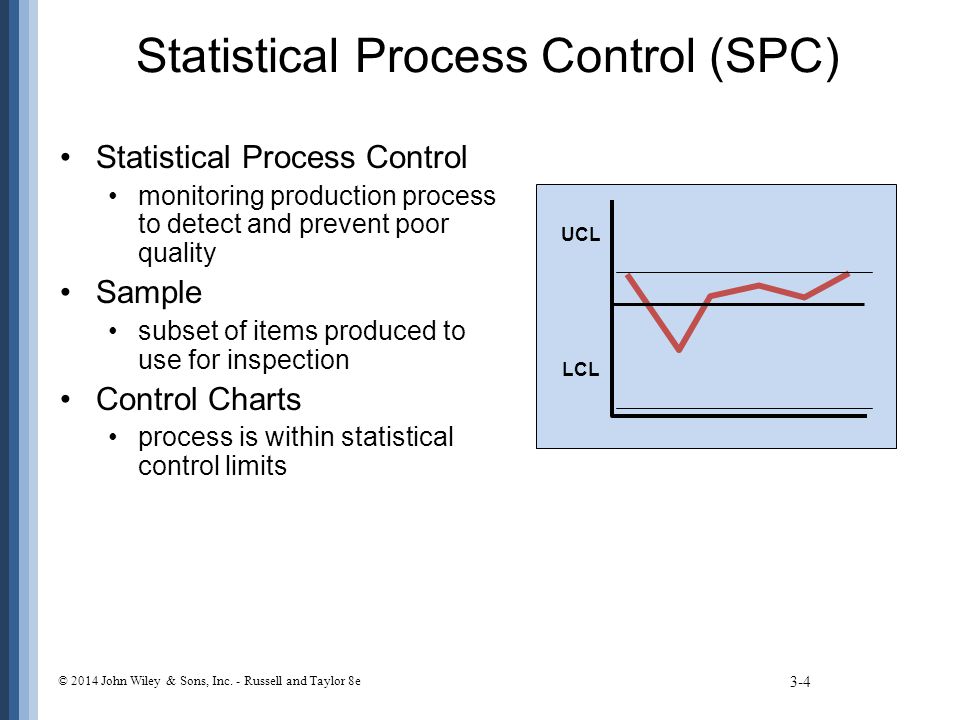
This is a quality control tool that uses statistical methods to ensure that a process operates at its most efficient. This is achieved through measuring aspects of a component to ensure that it meets the required standard throughout its production in order to eliminate waste.

Related image

Real time SPC contributes and assists with:

  • Reducing costs
  • Improving productivity
  • Decision making in real time
  • Reducing waste
  • Reducing variability in outcome
  • Discovering abnormalities
  • Speeding up process changes
Image result for statistical process control

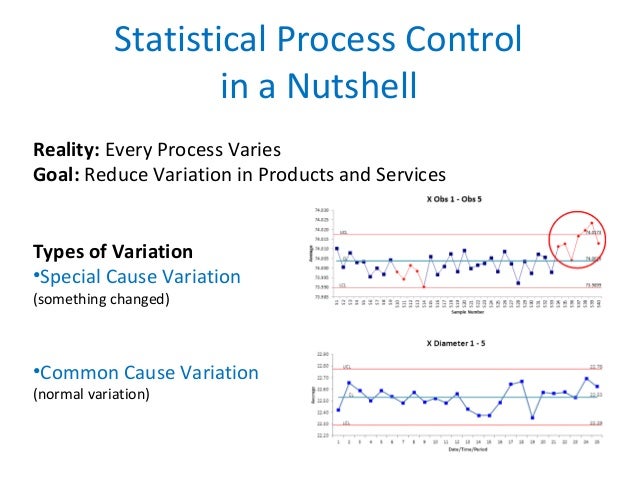
Statistical Process Control Charts:
Related image


Quality assurance (QA) [product]

This covers all activities from design to documentation. It also includes the regulation of the quality of raw materials, assemblies, products and components, services related to production, and management and inspection processes. 

Quality assurance is a way of preventing mistakes or defects in manufactured products and avoiding problems when delivering solutions or services to customers. Defect prevention in quality assurance differs subtly from defect detection and rejection in quality control, and has been referred to as a shift left as it focuses on quality earlier in the process.


Image result for quality assurance framework
Quality Assurance Framework

The Differences between QA, QC and SPC
QA is process oriented while QC is product oriented. QA deals in developing processes and systems that align with Quality Management. QC on the other hand deals with monitoring products.

For example, a QA engineer would develop a quality plan based on customer requirements and a QC engineer would monitor and ensure that all requirements of the quality plan are met during manufacturing. The QC engineer would only focus on making sure the product meets the requirements of the quality plan as set by the QA.

QA is the part of QM focused on providing confidence that quality requirements will be fulfilled. 

QC is the part of QM focused on fulfilling quality requirements. 
Differences between QC and QA


10.3: Computer Integrated Manufacturing

10.3
Computer Integrated Manufacturing
Essential Idea: Computer-integrated manufacturing uses computers to automatically monitor and control the entire production of a product.

Computer integrated manufacture (CIM) takes the concept of integration of separate manufacturing technologies and combines these with all aspects of a company's operations, not just those that are directly involved in the manufacture/

Under a CIM system, all teams can share the same information and easily communicate with one another. A CIM system uses computer networks to integrate the processing of production and business information with manufacturing operations to create cooperative and smooth-running production lines.


Elements of CIM: design, planning, purchasing, cost accounting, inventory control, distribution

DESIGN

  • In a CIM system this is accomplished by a design department through computer aided design while considering the product requirements. 
  • When design is completed it is tested or functions simulated on a screen before a prototype is made
  • Prototypes are maid using CIM machines
  • The design process creates the database required to manufacture the part

PLANNING

  • Planning department takes the design on the computer system and database established by the design department and enriches it with production data to produce a plan for the most efficient method of production of the product
  • Involves subsystems dealing with materials, facility, process, tools, manpower, capacity, scheduling, outsourcing, assembly, inspection, logistics and others.

PURCHASING

  • The purchase department orders the necessary materials to manufacture the product, keeping cost to a minimum
  • Just in time (JIT) philosophy is applied
  • Computer system is used to purchase orders and follow up, ensure quality in the production process of the vendor, log the received items, and more.
COST ACCOUNTING 

  • The finance department uses a computer system to deal with the financial resources of a company 
  • Such factors of cost accounting include:
    • Inventory valuation
    • Cost of goods sold valuation
    • Constraint analysis
    • Margin analysis
    • Variance analysis
    • Budgeting
INVENTORY CONTROL

  • Computerized inventory control systems make it possible to integrate the various functional subsystems that are a part of the inventory management into a single cohesive system.
  • An inventory control system encompasses all aspects of managing a company's inventories including:
    • Purchasing 
    • Shipping 
    • Receiving
    • tracking
    • Warehousing and storage
    • Turnover
    • Reordering

DISTRIBUTION

  • Distribution (or warehousing uses the computer system to aid in organizing the storage and retrieval of raw materials, components, finished goods as well as the shipment of items
  • Storage is automated using computer controlled vehicles that move the finished product from the manufacturing area to storage (and keeps track of the products)
  • Logistics and supply chain management assume great importance


Sunday, February 17, 2019

10.3: Computer Integrated Manufacturing (CIM)

10.3
Computer Integrated Manufacturing (CIM)
Essential idea: Computer-integrated manufacturing uses computers to automatically monitor and control the entire production of a product.

Computer Integrated Manufacture
CIM is a system of manufacturing that uses computers to integrate the processing of production, business and manufacturing in order to create more efficient production lines. Under a CIM system, all teams can share the same information and easily communicate with one another.

A CIM system uses computer networks to integrate the processing of production and business information with manufacturing operations to create cooperative and smooth-running production lines.
Image result for computer integrated manufacturing
Elements of CIM

Design 
In a CIM system, this is accomplished by a design department through computer aided design while considering the product requirements.

Planning

The planning department take the design and on the computer system and database established by the design department and enriches it with production data and information to produce a plan for the most efficient method production of the product.

Purchasing
The purchase department through the computer system orders the necessary materials to manufacture the product, keeping costs to a minimum.This means that materials/components are ordered as needed (JIT).

Cost accounting
The finance department uses a computer system to deal with the financial resources of a company. Planning of investment, working capital, and cash flow control, realization of receipts, accounting and allocation of funds are the major tasks of the finance departments.

Inventory control
Computerized inventory control systems make it possible to integrate the various functional subsystems that are a part of the inventory management into a single cohesive system. 

Distribution
Distribution (or warehousing) uses the computer system to aid in organizing the storage and retreival of raw materials, components, finished goods as well as shipment of items. 

10.2: Lean Production

10.2 
Lean Production
Essential idea: Lean production aims to eliminate waste and maximise the value of a product based on the perspective of the consumer.

Lean production considers product and process design as an ongoing activity and not a one-off task, and should be viewed as a long-term strategy.

Image result for lean production

Characteristics of lean production

Lean production aims to eliminate waste and maximize the value of a product based on the perspective of the consumer. Such characteristics include:

  1. Jit supplies
    Getting the right amount of material to the production line JIT
  2. Highly trained multi-skilled workforce
    Having experts in place to ensure that no time is wasted
  3. Quality control and continuous improvement 
    Checks are made at every stage of production to quickly identify and fix any problems that arise. Improvements to the system are actively sought.
  4. Zero defects 
    Ensuring that time, material and energy are not wasted producing a sub-standard product
  5. Zero inventory
    Products are manufactured JIT to be sold
Image result for lean production
Focuses on continual feedback and incremental improvement

Lean Production


Principles of Lean Production
There are several key principles of lean production. If any of these principles are not met this could result in failure or a lack of commitment.  Without commitment the process becomes ineffective.

10 principles of lean production:

  1. Eliminating waste
  2. Minimizing inventory
  3. Maximizing flow
  4. Pulling production from customer demand
  5. Meeting customer requirements
  6. Doing it right the first time
  7. Empowering workers
  8. Designing for rapid changeover
  9. Partnering with suppliers
  10. Creating a culture of continuous movement

Value Stream Mapping
Value stream mapping is a lean production management tool used to analyze current and future processes for the production of a product through to delivery to the consumer. Consider the contribution of value stream mapping to the design of an effective lean production method.
Image result for value stream mapping
Value stream mapping allows production managers to plan the manufacture of a product from start (purchase of raw materials) to finish (sale to customer) and identify potential problems in the system.

  • helps to identify Value and Waste in production


Workflow Analysis
Workflow analysis is the review of workflow processes in order to identify potential improvements. Value stream mapping provides a 'big picture' of the manufacturing processes, but workflow analysis is concerned with the details of the production line.

Identifies potential improvements by considering the sequence, tools and even worker movement to ensure the highest possible efficiency in the system.


Product Family
The concept of standardized specifications, components or assemblies within a product family or associated brands allows companies to create a competitive advantage. A product family is a group of products using similar processing methods.

Image result for apple products

Role of the Workforce
The development of a highly skilled workforce can build deep understanding of how the production process works and allows workers at all levels to identify areas of the workflow to be improved.


  • reduces costs 
  • empowers the workforce
  • gives them a sense of ownership and loyalty to the company 

Kaizen
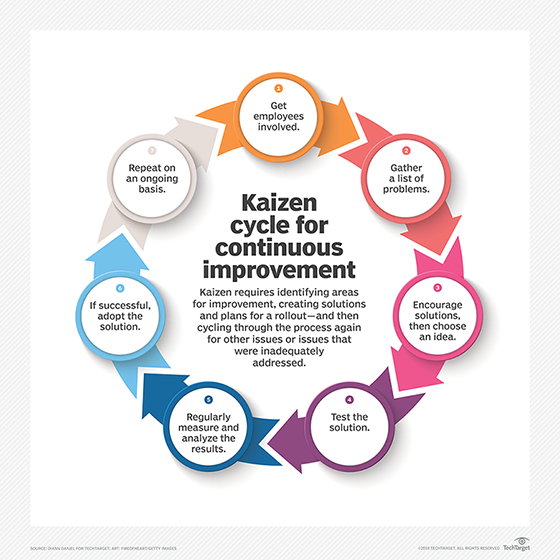
Kaizen is a culture of continuous improvement originating in Japan and considered an important aspect of an organization's long-term strategy. It is a philosophy and commitment to continuous process and product improvement of processes in manufacturing, engineering, business management or any process.
Image result for kaizen

Image result for toyota kaizen methods
Toyota as a company embraces the ways of Kaizen in their manufacturing


Lead time
Lead time refers to the time quoted to customers (usually in days or weeks) between the date of purchase and the date of delivery. (The time between the initiation and the execution of a process)

In industry, lead time reduction is an important part of lean manufacturing.
Image result for lead time in manufacturing
The 5 Ss: sorting, stabilizing, shining, standardizing, sustaining the practice
The Five S's are a formal approach to cleaning and organizing the workplace involving these five steps;

  • Sort
  • Set
  • Shine
  • Standardize
  • Sustain
7 Wastes


The 7 wastes: overproduction, waiting, transporting, inappropriate processing, unnecessary inventory and unnecessary/excess motion.
7 Wastes
Of all these wastes, overproduction is the worst as it inherently incorporates all of the others. When you manufacture a product that will never be sold, the following happens;

  • The raw material used is wasted
  • The energy of the manufacturer is wasted
  • The time and movement of the workers is wasted
  • The transportation of the raw material and the finished product is wasted

Advantages and Disadvantages of Lean Production
Advantages

  • Minimizes waste, reduces cost
  • less impact on the environment
  • Quickly adaptable to the market pushes
  • Little capital is tied up in raw material or unsold stock
  • Increased autonomy for workers - leading to higher moral
Disadvantages
  • One problem in production stops the whole process
  • Manufacturers rely on suppliers, one mistake by them halts production
  • More suitable for large scale production
  • When a certain level of refinement is met, using lean methods to squeeze more economy from production can discourage workers, reversing positive motivation and undermining your leadership


10.1: Just in Time (JIT) and Just in Case (JIC)

10.1 
Just in Time and Just in Case
Essential idea: Just in time and just in case are opposing production strategies utilised by the manufacturer.

Just in Time (JIT)
A situation where a company does not allocate space to the storage of components or completed items, but instead orders or manufactures them when required. Large storage areas are not needed and items that are not ordered are not made.

Advantages

  1. Production to order with materials being supplied JIT cuts down on storage space
  2. Reduced capital investment as capital is not tied up in unused raw materials or unsold products
  3. Reduced work in progress
  4. Increased efficiency
  5. Improved stock control
  6. Saves money - no need for storage costs

Disadvantages

  1. If any of the stock is faulty then more has to be ordered from a supplier which could slow down the lead time and production processes
  2. Companies may not benefit for economies of scale if they are purchasing smaller qualities.
Example:
Dell's Just in Time Manufacturing system

Related image

Just-in-time (JIT) manufacturing is specific type of inventory production strategy that is used to improve a company’s return on investment through a cutback of stock held. Dell, a computer oriented firm, has integrated JIT which cuts on their need for stock management.


Just in Case (JIC)
Just in Case manufacturing is the traditional model of production, in which products are created in advance and in excess of demand. According to the principles of lean production, the JIC model wastes resources because inventories must be maintained. The JIT model of manufacturing was developed to eliminate the wastefulness of the traditional model.

Advantages

  1. Every customer becomes a sale (they can buy it straightaway)
  2. The manufacturer has a 'buffer' of goods in stock in case of unforeseen circumstances
  3. The manufacturer can respond quickly to a demand for a product
  4. The manufacturer can produce a steady flow of product and have a stable workforce
  5. Less capital costs than JIT - information and communication technology systems , stock control systems
  6. Able to stock pile supplies or finished products.

Disadvantages

  1. Shop owners have to hold a lot of inventory
  2. A large investment at the start of the business
  3. It occupies a lot of space, which can be expensive
  4. These products might spol leading to waste
  5. If trends change, you could be left with a lot of unsellable products

3.3 Physical Modelling

3.3 Physical Modelling Essential Idea: A physical model is a three-dimensional, tangible representation of a design or system Designers ...